It's true! Wow, this is a weird feeling to be in the spotlight like this, even if only to a relatively small extent (which this clearly is). Anyway, some background is in order: I submitted a paper to one of Kirkegaard's journals last year despite not agreeing with him on many controversial issues only to later decide to withdraw it while it was still being "reviewed" on one of their open "peer-review" forums (by reviewers who often have little/no relevant expertise). Anyway, this is about a post I recently made on reddit from a subreddit from which I have since been banned (namely, /r/heredity).
Basically I was reiterating arguments I considered to be compelling that I came across in Misbehaving Science, a 2014 book by Aaron Panofsky. I bought this book online through Amazon and finished reading it last summer. The arguments I was outlining were that behavior genetics (BG) researchers, when responding to their critics, tend to focus on relatively narrow statistical and empirical issues, rather than more fundamental, and thus important, underlying theoretical/conceptual problems. In doing so I was also trying to draw attention to arguments made by one prominent critic of the common genetic-deterministic interpretation of heritability coefficients, Peter Taylor, in this paper. I had noticed that others on this subreddit had been citing the work of Neven Sesardic to defend heritability and the way the concept is often used in the BG field. With this background established, I will quote from Kirkegaard's post:
"There’s a certain type of person that doesn’t produce any empirical contribution to “Reducing the heredity-environment uncertainty”. Instead, they contribute various theoretical arguments which they take to undermine the empirical data others give. Usually, these people have a background in philosophy or some other theoretical field. A recent example of this pattern is seen on Reddit, where Jinkinson Payne Smith (u/EverymorningWP) made this thread:
And then he quotes from the post I made that I was describing above. Honestly almost as surprising as him blogging about me is the fact that he knows my middle name. I must have posted it somewhere--I know it's on this blog, I guess some other places (Wikipedia, I think).
Here is what he says after quoting my post: "So: It works in practice, but does it work in (my) theory? These philosophy arguments are useless. Any physics professor knows this well because they get a lot of emails allegedly refuting relativity and quantum mechanics using thought experiments and logical arguments (like Time Cube). These arguments convince no one, even if one can’t find the error in the argument immediately (like in the ontological argument). It works the same way for these anti-behavioral genetics theoretical arguments. If these want to be taken seriously, they should produce 1) contrasting models, 2) that produce empirically testable predictions, and 3) show that these fit with their model and do not fit with the current behavioral/quantitative genetics models.
And then he calls me out by name! Specifically, he does so in the last paragraph of his post, which I have copied and pasted verbatim below:
"I must say that I do feel some sympathy with Jinkinson’s approach. I am myself somewhat of a verbal tilt person who used to study philosophy (for bachelor degree), and who used to engage in some of these ‘my a priori argument beats your data’ type arguments. I eventually wised up, I probably owe some of this to my years of drinking together with the good physicists at Aarhus University, who do not care so much for such empirically void arguments."
For a while I have been looking at many of the BG researchers focusing on genetics, race, IQ, etc. and I have suspected that they seem to really get off on using the word "empirical". This perception has only been bolstered by not only Kirkegaard himself, but also by many other people with whom I have been arguing about these topics on Reddit, as well as other articles I have read in the peer-reviewed BG literature.
One more thing: the point Kirkegaard made in the immediately above paragraph is reminiscent of a point someone else made on the same Reddit post that started all this. I don't remember who, but someone (maybe Kirkegaard himself) did mention physics and arguing that people can come up with silly theoretical concepts/thought experiments that seem to refute well-established theories in physics, but which collapse upon empirical scrutiny. Not knowing much of anything about physics, I am not going to dispute this point except to say that theoretical concerns are not necessarily invalid, nor are they necessarily trumped or refuted by statistics. Furthermore, it should be borne in mind that statistics or empirical evidence is not necessarily meaningful; it must be interpreted in a way that accurately reflects the underlying processes at work in what is being studied.
Saturday, January 19, 2019

Thursday, January 10, 2019
Some hypothetical electoral maps
What would have happened in 2016 if every state had shifted from the 2012 election by the same amount it shifted from the 2008 election in 2012?
First, as a reference, let's look at the actual results of the 2012 election (taken from Wikipedia and made on 270towin.com):
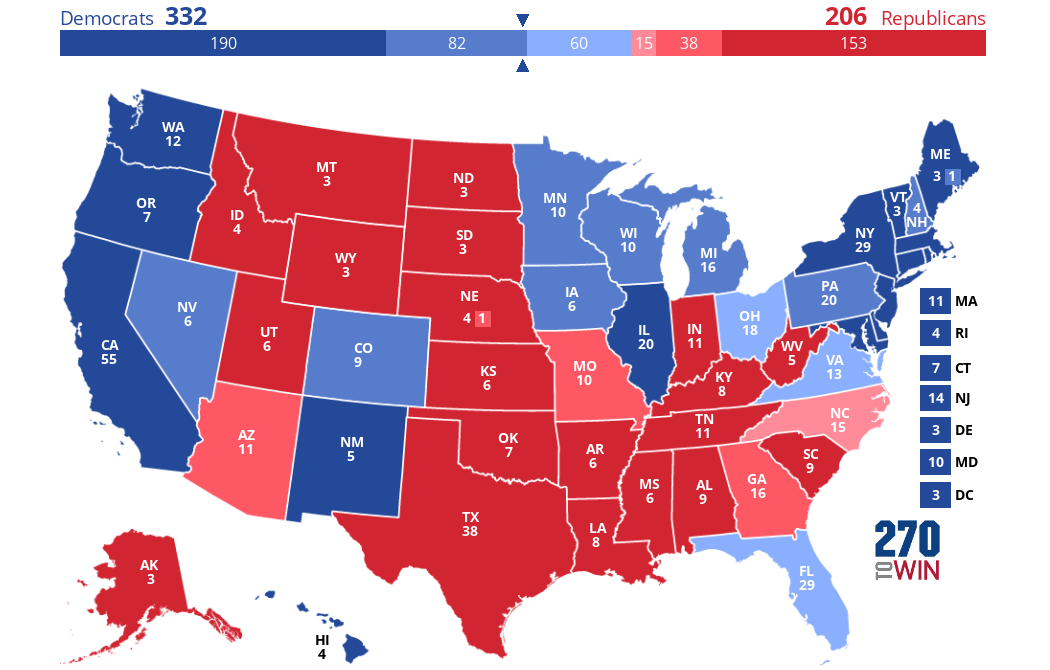 In this map ("map #1"), all states that were won by the Democrat/Republican by <5 points are in light blue and light red, respectively. All states won by between 5 and 10 points are medium dark blue (e.g. Pennsylvania) or medium dark red/pink (e.g. Arizona). Finally, all states won by >10 points either way are solid blue/red.
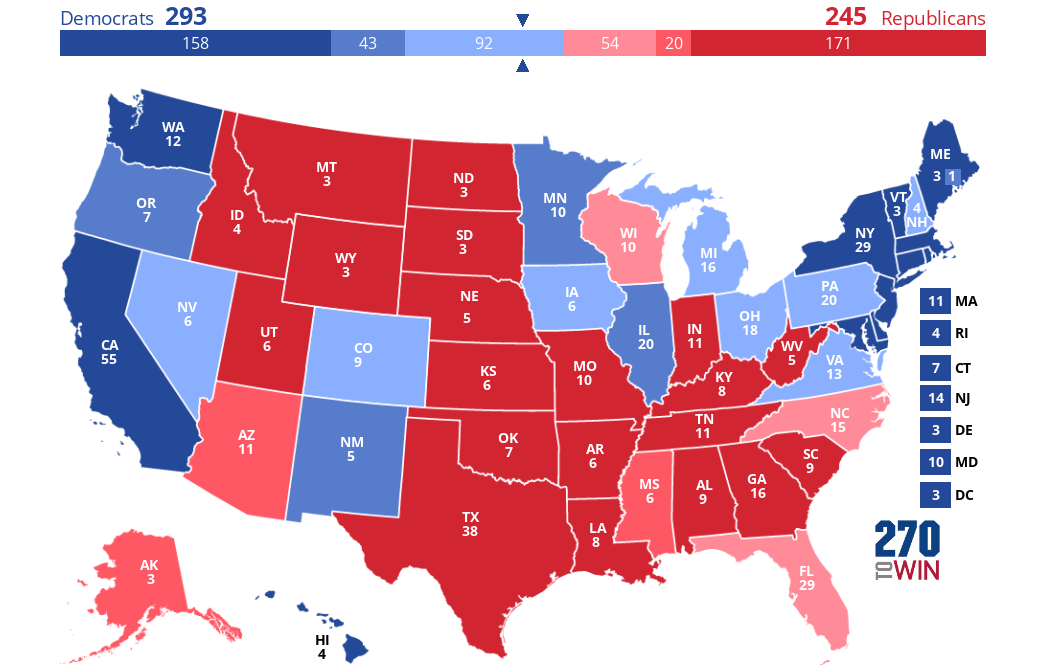
Anyway, what's the answer to the question in the first sentence of this post? What would the outcome of the 2016 election have been? To answer this question, I used data from Dave Leip's extremely useful Atlas of Presidential Elections and created this map (or "map #2"), also on 270towin.com (note that all subsequent maps are colored the same way as the first one):
And finally, here is a map based on Trump's state-level net approval ratings (as of last month, according to Morning Consult). (Net approval rating = % who approve of Trump - % who disapprove.) Here, the coloring is the same as before, but I should note that if the approval rating was exactly + or -10%, it was placed in the "medium" color category (e.g. net rating of 10% = medium red, not dark red). This affected only two states: IA and NV (Trump's net approval rating was -10% in both states).
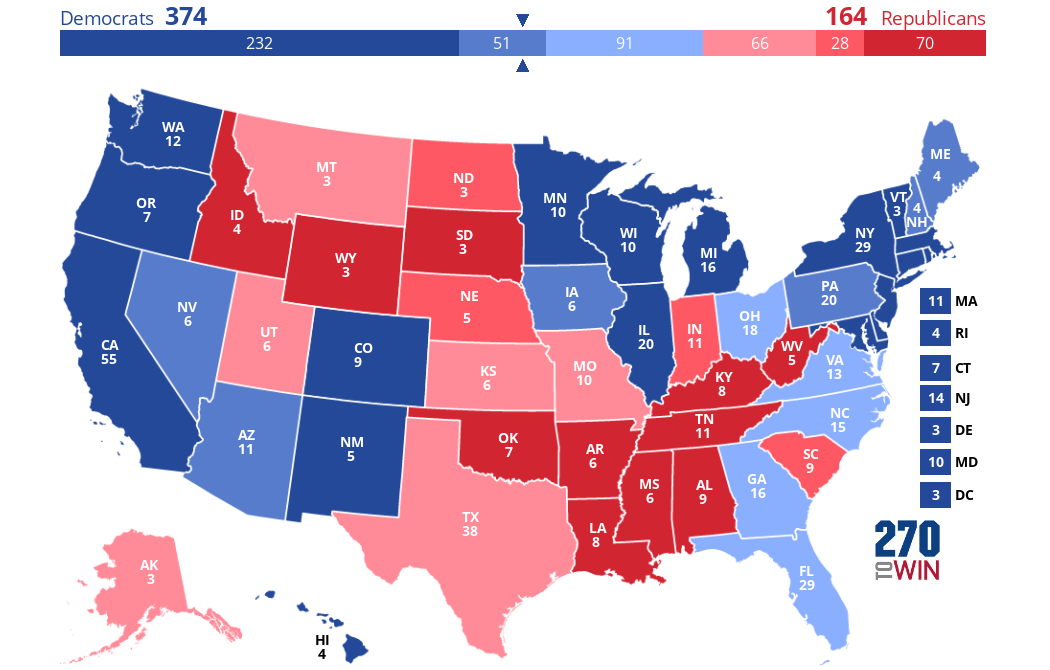
First, as a reference, let's look at the actual results of the 2012 election (taken from Wikipedia and made on 270towin.com):
Anyway, what's the answer to the question in the first sentence of this post? What would the outcome of the 2016 election have been? To answer this question, I used data from Dave Leip's extremely useful Atlas of Presidential Elections and created this map (or "map #2"), also on 270towin.com (note that all subsequent maps are colored the same way as the first one):
So the answer, in short, is the Democrat wins the Electoral College 293-245. This would have represented the Democrat getting 57 more (and the Republican getting 57 fewer) electoral votes than their party's candidate actually did in 2016. Note that, although this is not shown in the map above, there are 3 states expected to have margins of <1% here (and which could thus be marked as tossups): WI, NV, and PA.
Perhaps the most notable thing about this map is that, with respect to the party that wins each state, it is identical to the 2012 electoral map with only two exceptions: Florida and Wisconsin have both flipped from D to R.
What else changes in this predicted map compared to the 2012 results? NV, CO, IA, MI, PA, and NH all turn a shade lighter blue, while MO, GA, and the 2nd congressional district of NE all turn a shade darker red. Mississippi and Alaska both turn a shade lighter red because Obama did better there in 2012 than in 2008, to the extent that both states are expected to be won by the R candidate by between 5% and 10% in 2016.
Here are the states where the margin in 2016 is predicted to be <5% either way. States predicted to flip will be underlined from here on out.
| Michigan | 2.5% | |
| Iowa | 2.1% | |
| Colorado | 1.8% | |
| New Hampshire | 1.6% | |
| Virginia | 1.5% | |
| Ohio | 1.4% | |
| Nevada | 0.9% | |
| Pennsylvania | 0.5% | |
| Wisconsin | -0.1% | |
| Florida | -1.0% | |
| North Carolina | -4.4% |
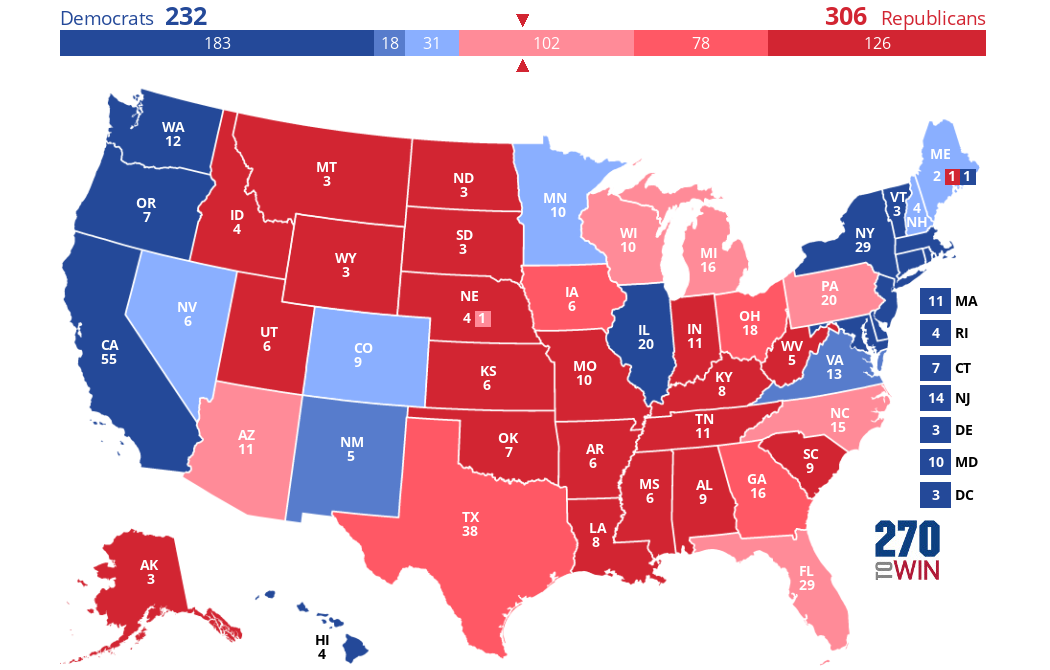
Notably, in addition to mostly being similar to what happened in 2012, map #2 also comports pretty well with what actually happened in the 2016 election (i.e. Trump won both Florida and Wisconsin), except that he also won four additional pale blue states on this map (IA, MI, OH, and PA). He also won the medium-dark-blue 2nd congressional district of Maine by over 8%, though here it is predicted to go D by almost 6%, and Obama won it in 2012 by almost 10%! We also see that of these eleven states, Clinton won only four of them (CO, NH, VA, and NV).
For comparison, I have illustrated the results of the 2016 election in the map below (map #3).
The fact that Trump won every state predicted to be won by the Republican in map #2, as well as 4 states (and 1 congressional district) predicted to go Democratic, further indicates that he did better (at least relative to Clinton) than one would normally expect, even accounting for the generally pro-R shift the country was already undergoing.
In addition to the party differences noted above, here are also some shading differences between map #2 and the actual 2016 election (i.e. states that were predicted to be won by the correct party, but by a margin in the wrong color range) are as follows:
- MS and AK are medium-red on map #2, but both states were dark-red in 2016 (Trump won then both by >10 points).
- TX and GA are both dark-red on map #2, but both states were medium-red in 2016 (Trump won them both by between 5 and 10 points).
- VA is light blue on map #2, but because Hillary won it by between 5 and 10 points, it was medium-blue in 2016.
- ME is dark blue on map #2, but it should be light blue because Hillary won it by <5 points.
- MN and OR are both medium-blue on map #2, but MN should be light blue and OR should be dark blue (Hillary won MN by <5 points and OR by >10 points).
- AZ should be light red, not medium red (as it is on map #2), because Trump won it by <5 points.
- NE's 2nd congressional district is dark red on map #2, but it should be light red, because Trump won it by <5 points.
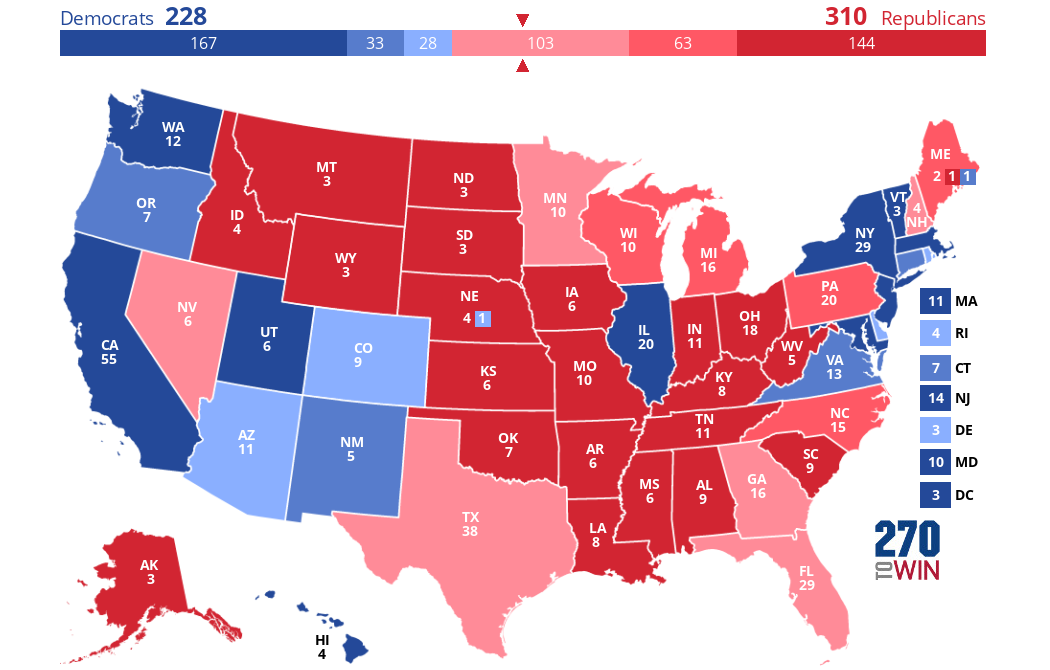
What about if the 2020 election was based on the shifts that happened from 2012 to 2016? Then this map (map #4) would be the result (same data sources and produced on the same website as above):
Weird fact: on the website the purple states were shown as having red and blue stripes. Adding the image through its URL here apparently changes the appearance of mixed electoral vote states for some reason. Anyway, here we see the Republican (presumably Trump) getting 310 electoral votes--four more than he got in 2016! This should not be a surprise because of course Trump did better than Romney in 2012, at least in most states; that's the reason he won when Romney didn't. In this map, four states are predicted to flip from D to R: Maine, Minnesota, Nevada, and New Hampshire. (Maine flipping means that Trump would win two of the state's electoral votes; he is also predicted to win its 2nd congressional district again, but to lose its 1st, which would give him 3 votes and the D candidate one vote from the state). Meanwhile, two states--AZ and UT--are predicted to flip from R to D, along with Nebraska's 2nd congressional district.
Utah is a weird outlier on this map because it voted 30 points more Democratic in 2016 than in 2012. So if you take the result of the 2016 election in Utah (Trump wins by 18 points) and add 30 points in the D candidate's favor, this gives you a 12% D win, and since >10% margins here are shown in solid red/blue, Utah is solid blue on this map. But of course the odds of UT shifting 30% towards the Democrats again are pretty low, especially since Romney had no difficulty getting elected there last year. But then again, a recent poll suggests that a slight majority of Utah voters would not vote for Trump next November, so maybe it could happen: clearly voters there like Trump much less than normal establishment Republicans.
Some other weird facts about this map:
- Texas is expected to be really close: Trump is predicted to win it by only 2.2%, making it the second-closest state that he wins (behind only Nevada at 1.9%).
- Rhode Island is also predicted to be surprisingly close, with a D win predicted to be by only 3.6% (Trump shifted it way to the right in 2016). Delaware is a similar story (D expected margin of victory: 4.2%).
- My own state, Georgia (along with Texas, also not typically considered a swing state), is expected to be closer than normal swing states like Florida and New Hampshire. This is caused by the fact that both GA and TX voted more Democratic in 2016 than in 2012--especially Texas, which swung almost 7% in the D's favor.
- Ohio and Iowa, though long considered swing states, are both expected to be staunchly Republican in 2020--Iowa is predicted to be won by Trump by a larger margin than Mississippi, and Ohio is expected to be won by more than South Carolina!
| Colorado (4.4%) |
| Delaware (4.2%) |
| Rhode Island (3.6%) |
| Nebraska (2nd) (2.7%) |
| Arizona (2.0%) |
| Nevada (1.9%) |
| Texas (2.2%) |
| Georgia (2.5%) |
| Florida (3.3%) |
| Minnesota (4.7%) |
| New Hampshire (4.8%) |
And finally, here is a map based on Trump's state-level net approval ratings (as of last month, according to Morning Consult). (Net approval rating = % who approve of Trump - % who disapprove.) Here, the coloring is the same as before, but I should note that if the approval rating was exactly + or -10%, it was placed in the "medium" color category (e.g. net rating of 10% = medium red, not dark red). This affected only two states: IA and NV (Trump's net approval rating was -10% in both states).
So, no surprise, Trump's approval ratings are net negative in every state he lost to Clinton in 2016. The (somewhat) surprising thing about this map is that they are also net-negative in nine states that he won in 2016: namely, AZ, FL, GA, NC, OH, PA, IA, WI, and MI. Of these, Trump's net approval rating is the lowest in MI and WI (both -12%!).
Tuesday, December 18, 2018
New paper: the accuracy of FiveThirtyEight's 2018 election predictions: an exploratory analysis
I submitted a paper with this title to SocArXiv, which you can read here in the unlikely event that you want to. (The content of that paper was originally posted here but it has since been removed, 'cause there's no need for it to be in 2 places at once.)
Friday, December 7, 2018
Stereotype accuracy part II
(Introductory author's note: all quotes in this post that I did not write will be in Courier font, but everything else will be in Times New Roman.)
In a previous post, I looked at the obviously fishy claims that Rutgers social psychology professor Lee Jussim and his colleagues (but especially Jussim himself) have been making regarding the purported accuracy of stereotypes. Before broadening this post to look at the many questionable arguments Jussim has made about many other topics, I will point out that Jussim's claim that stereotypes are usually very accurate (despite being false) has crept its way into a number of recent peer-reviewed papers that cite it as evidence of a supposedly widespread, structural bias in favor of liberal views in social psychology. Consequently, in this post I will critique some recent articles not written by Jussim or his colleagues, but which cite their research on stereotypes and portray it in a favorable light.
So first I need to sum up the argument being made by those advancing Jussim et al.'s claims about stereotype accuracy: ostensibly, there is overwhelming evidence that stereotypes are moderately to highly accurate, but liberal social psychologists (i.e. almost all social psychologists), blinded by their ideological preconceptions, refused to even approach or consider this evidence. Martin (2016), for instance, claims,
In the field of behavior genetics (BG), this style of argumentation often manifests as behavior genetics researchers calling their critics "blank slatists", or saying they have some sworn ideological allegiance to total environmental determinism/the standard social science model when explaining human behavior. This lets BGists portray themselves as offering the reasonable idea of maybe letting genes be part of the equation that leads to human behavioral traits, as an alternative to those nutjobs who want to pretend that human genes and evolution don't even exist. Here we see Martin similarly using this approach to avoid addressing specific points made by one's critics, and instead trying to elicit sympathy from readers by portraying the author as under attack by the PC brigade that supposedly controls the vast majority of academia.
Where was I? Oh yeah, Martin's article. Martin was saying that the idea of stereotypes being accurate a) could've been researched empirically for a long time, but b) wasn't researched empirically nearly as often as it could have been, because c) almost all social psychologists were blinded by the taboo against such research by their supposedly all-encompassing liberal ideologies. Further, he claims that d) when a handful of brave, Galileo-like mavericks finally stood up to the leftist cabal that rules almost all of the social psychology field with an iron fist, e) they proved that stereotypes are actually very accurate, on average, which f) proves that stereotypes arise from accurate perceptions of reality, not prejudice.
Before addressing these arguments I want to point out another fundamental issue with the "stereotypes are accurate" argument I did not mention in my previous post on Jussim's work in this area. Specifically, as Jussim himself acknowledges, there is not a single dimension of "accuracy" on which a perception or belief can be assessed, but rather several possible "scales" on which one may attempt to do so. In a 2015 journal article, for example, Jussim et al. note that there are two distinct ways that stereotype accuracy can be assessed. These two ways are discrepancy scores and correspondence. As Jussim et al. further explain,
Though the above points I made seem troubling (though I'm hardly an impartial judge of how compelling my own arguments are), I think that the biggest problem with this research is that, ironically, it stereotypes stereotypes themselves by referring to them in blanket terms as "accurate". This ignores not only the highly problematic nature of referring to entire groups as all possessing a characteristic without acknowledging variation within groups on that characteristic, but also the fact that even by these researchers' own criteria, some stereotypes are decidedly inaccurate. Political stereotypes, for instance, were said to "exaggerate group differences" by Jussim et al. (2015). In addition, these authors note that "Empirical reports based on independent samples from around the world (e.g., McCrae et al., 2013) have consistently found little national-character stereotype accuracy". Consequently, blanket statements about the "accuracy" of stereotypes serves to commit the very fallacy of generalization that psychologists have been criticizing stereotypes for for decades now: it ignores that not all members of group x (in this case, stereotypes) have characteristic y (in this case, accuracy).
Sources
Jussim et al. 2015
Lockenhoff et al. 2014
Panofsky 2014
Martin 2016
In a previous post, I looked at the obviously fishy claims that Rutgers social psychology professor Lee Jussim and his colleagues (but especially Jussim himself) have been making regarding the purported accuracy of stereotypes. Before broadening this post to look at the many questionable arguments Jussim has made about many other topics, I will point out that Jussim's claim that stereotypes are usually very accurate (despite being false) has crept its way into a number of recent peer-reviewed papers that cite it as evidence of a supposedly widespread, structural bias in favor of liberal views in social psychology. Consequently, in this post I will critique some recent articles not written by Jussim or his colleagues, but which cite their research on stereotypes and portray it in a favorable light.
So first I need to sum up the argument being made by those advancing Jussim et al.'s claims about stereotype accuracy: ostensibly, there is overwhelming evidence that stereotypes are moderately to highly accurate, but liberal social psychologists (i.e. almost all social psychologists), blinded by their ideological preconceptions, refused to even approach or consider this evidence. Martin (2016), for instance, claims,
"...stereotype accuracy has been considered a taboo topic, and only a small number of researchers have investigated if stereotypes are accurate (e.g., Jussim 2012b). Much of this research has shown that stereotypes are indeed accurate (on average), particularly in direction. These findings contradict the assertion by some scholars that stereotypes primarily arise from intergroup envy or scorn (e.g., Fiske 2010). Rather, they develop from valid observations of the social world. Far from being the foolish mistake-makers that social psychologists have made them out to be (Baumeister 2010), humans are mostly perceptive observers. Were it not for the taboo against accuracy research, this scientific discovery might have occurred earlier."Hoo boy, there's a lot of bullshit there! Firstly, we see the repeated victim mentality of anyone pushing a controversial claim that they claim is supported by strong scientific evidence: they are attacking their critics as motivated by political correctness and reluctant to even touch certain oh-so-controversial topics with a ten-foot pole because of their fear of "taboos". This is reminiscent of the argument style behavior geneticists often use, which also involves accusing their critics of political, rather than scientific, motivations. Aaron Panofsky's 2014 book Misbehaving Science refers to this style of (ad hominem) argumentation as "hitting-them-over-the-head" style. Panofsky states that the goal of this discursive style "...was not to seek synthesis, integration, or sober rational persuasion but to engage in polemical scientific attack, declaring themselves as crusaders who would rout the antigenetics heresy gripping behavioral science" (Panofsky 2014, p. 142).
In the field of behavior genetics (BG), this style of argumentation often manifests as behavior genetics researchers calling their critics "blank slatists", or saying they have some sworn ideological allegiance to total environmental determinism/the standard social science model when explaining human behavior. This lets BGists portray themselves as offering the reasonable idea of maybe letting genes be part of the equation that leads to human behavioral traits, as an alternative to those nutjobs who want to pretend that human genes and evolution don't even exist. Here we see Martin similarly using this approach to avoid addressing specific points made by one's critics, and instead trying to elicit sympathy from readers by portraying the author as under attack by the PC brigade that supposedly controls the vast majority of academia.
Where was I? Oh yeah, Martin's article. Martin was saying that the idea of stereotypes being accurate a) could've been researched empirically for a long time, but b) wasn't researched empirically nearly as often as it could have been, because c) almost all social psychologists were blinded by the taboo against such research by their supposedly all-encompassing liberal ideologies. Further, he claims that d) when a handful of brave, Galileo-like mavericks finally stood up to the leftist cabal that rules almost all of the social psychology field with an iron fist, e) they proved that stereotypes are actually very accurate, on average, which f) proves that stereotypes arise from accurate perceptions of reality, not prejudice.
Before addressing these arguments I want to point out another fundamental issue with the "stereotypes are accurate" argument I did not mention in my previous post on Jussim's work in this area. Specifically, as Jussim himself acknowledges, there is not a single dimension of "accuracy" on which a perception or belief can be assessed, but rather several possible "scales" on which one may attempt to do so. In a 2015 journal article, for example, Jussim et al. note that there are two distinct ways that stereotype accuracy can be assessed. These two ways are discrepancy scores and correspondence. As Jussim et al. further explain,
"One method of assessing accuracy is not “better” than the other; each contributes unique information (Jussim, 2012; Ryan, 2002). Discrepancy scores indicate how close perceivers’ stereotypes come to being perfectly accurate (scores of 0 reflect perfect accuracy). Correspondence indicates how well people’s beliefs covary with criteria" (Jussim et al. 2015, p. 492).So it would behoove those who want to make confident claims about the "accuracy" of stereotypes to make sure that they use both methods (or take into account studies that do so) before concluding that stereotypes are either accurate or inaccurate. So surely, when Jussim et al. (2015) claim in their paper's abstract that the accuracy of stereotypes is "one of the largest and most replicable findings in social psychology", they are basing this on both types of studies, right? This is not at all the impression you get from their table 2, which claims to present, and I am not making this up, "Stereotype Accuracy Correlations From Over 50 Studies Showing That Stereotypes Are More Accurate Than Social-Psychological Hypotheses". They appear to only be paying attention to correlations between perceived and actual group characteristics, without paying attention to discrepancy scores, in coming to the obviously provocative conclusion that stereotype accuracy is actually greater than that of social psychological hypotheses collectively. That being said, they do acknowledge the existence and results of discrepancy-score studies bearing on this topic, e.g. when they say "Although not every study examined discrepancy scores, when they did, a plurality or majority of all consensual stereotype judgments were accurate. For example, an international study of accuracy in consensual gender stereotypes about the Big Five personality characteristics found that discrepancy scores for all five reflected accuracy (Lockenhoff et al., 2014)." However, it should be pointed out that it is more difficult to assess the relative "accuracy" of psychological hypotheses and stereotypes when the latter are assessed based on discrepancy scores (e.g. 1 SD) rather than correlation coefficients. Further, the statement that Lockenhoff et al. (2014) "found that discrepancy scores for all five reflected accuracy", referring to the Big Five model of personality traits (Neuroticism (N), Extraversion (E), Openness to Experience (O), Agreeableness (A), and Conscientiousness (C)), seems to be rather at odds with the following quote from that very paper (Lockenhoff et al. 2014, p. 685): "Across all facets of N (and for N1: Anxiety in particular), assessed sex differences appeared to be more pronounced than GSDs [gender stereotype differences], and this was true for both self-reports and observer-ratings."
Though the above points I made seem troubling (though I'm hardly an impartial judge of how compelling my own arguments are), I think that the biggest problem with this research is that, ironically, it stereotypes stereotypes themselves by referring to them in blanket terms as "accurate". This ignores not only the highly problematic nature of referring to entire groups as all possessing a characteristic without acknowledging variation within groups on that characteristic, but also the fact that even by these researchers' own criteria, some stereotypes are decidedly inaccurate. Political stereotypes, for instance, were said to "exaggerate group differences" by Jussim et al. (2015). In addition, these authors note that "Empirical reports based on independent samples from around the world (e.g., McCrae et al., 2013) have consistently found little national-character stereotype accuracy". Consequently, blanket statements about the "accuracy" of stereotypes serves to commit the very fallacy of generalization that psychologists have been criticizing stereotypes for for decades now: it ignores that not all members of group x (in this case, stereotypes) have characteristic y (in this case, accuracy).
Sources
Jussim et al. 2015
Lockenhoff et al. 2014
Panofsky 2014
Martin 2016
Wednesday, October 31, 2018
Gottfredson vs. Gottfredson
I'd like to introduce you to Linda Gottfredson, former professor of educational psychology at the University of Delaware and recipient of her very own page on the SPLC's "fighting hate" website. But if you've been reading this blog for long enough you'll already have seen me talk about some of Gottfredson's work. Specifically, last July I critiqued an article she wrote in 2013 lavishing praise on racialist psychologist J. Philippe Rushton and disparaging his detractors. But here I wanted to look at her work in "g theory" over a long period of time and try to understand exactly what she thinks about the topic.
Brief overview before I start: g theory is based around the idea that there is a single "general intelligence", aka g (note italics: that's important), that IQ tests measure (though of course some better than others). The evidence for the existence of this g (aka "g factor" or "general factor") is said to be, above all else, the positive correlations between scores on different types of cognitive ability tests--even those that are very different in their scope and subject matter. g theorists thus tend to talk about people who are very intelligent as having high levels of g, and vice versa, thus implicitly assuming that "intelligence" can be "objectively determined and measured" by IQ tests in all people everywhere in the world with no exceptions. (The "objectively determined and measured" quote is a reference to the 1904 article by psychologist Charles Spearman that started this "theory".)
So I wanted to start by trying to answer this question: does Gottfredson believe that IQ/g is a fixed quality that cannot be changed by environmental interventions, or does she acknowledge that people are not born with a fixed, immutable quantity of intelligence, and that they can be made smarter by certain environmental interventions and changes? Let's try to look at some quotes from her previous writings to get an answer to this question (all emphases are mine):
Gottfredson (1994, p. 15): "That IQ may be highly heritable does not mean that it is not affected by the environment. Individuals are not born with fixed, unchangeable levels of intelligence (no one claims they are)."
Gottfredson (2000): "“Genetic” does not mean “fixed” or “unchangeable.” Just as genetically caused differences are not necessarily irremediable (consider diabetes and poor vision), environmental effects are not necessarily reversible (consider lead poisoning and head injuries). Both sources of low IQ may be preventable to some extent. Genetic screening and gene therapy, for instance, are both intended to prevent genetic disorders such as mental retardation."
Gottfredson (2003, p. 114): "No g theorist claims that g is “fixed.” This is a canard and distracts readers from the pertinent point, which is that individual differences in g become highly stable and more heritable by adolescence."
Gottfredson (2009, p. 415): "...if you state that people’s IQ scores are stable over time or highly genetic (both true), many people will hear you claiming that intelligence level is fixed in stone from birth (false)—unless you anticipate and correct that common misunderstanding."
Seems clear enough. Linda Gottfredson doesn't think that someone's IQ/intelligence/g is a fixed number, as is evident from all of the quotes cited above. In other words, it appears that she is willing to acknowledge the malleability of intelligence with respect to social/educational interventions. But perhaps she actually believes the exact opposite: that intelligence (i.e. IQ score) is a fixed, genetically determined quantity that we can't significantly change. Don't take my word for it, though; listen to what she herself says in the very sources I quoted above:
So in practice, she is saying that people's IQs tend to stay at about the same value (after childhood, anyway), even though in theory, she acknowledges that this doesn't have to happen. And in her 2000 article that I cited above, she further says that we might be able to raise people's IQs by saying, "Both [genetic and environmental] sources of low IQ may be preventable to some extent", but then switches from theoretical optimism to supposedly realistic pessimism by saying we can't currently do it permanently (or at least we couldn't in 2000).
And in 2016, she wrote, "Were the distribution of g unstable or malleable, g's effect sizes for various types of performance and life outcomes would not remain so regular, so consistent, so patterned decade after decade at the population level (cf. Gordon, 1997)" (Gottfredson 2016, p. 125; emphasis in original).
Ugh, so confusing. IQ is malleable, but it isn't, at least not by any method that exists now? I wonder which Linda Gottfredson we are to believe? This kind of ambiguity is brought to you by what Howard Gardner dubbed "scholarly brinkmanship": going really close to an extreme conclusion, very strongly implying it, but being careful not to directly state it. Here we see Gottfredson engaging in scholarly brinkmanship with regard to the idea of genetic determinism of people with low IQ and society's putative inability to do anything about it (aka "genetic fatalism", Alper & Beckwith 1993).
There's more where that came from: she often emphasizes that research on the supposed genetic basis of black-white IQ differences doesn't necessarily have any policy implications:
Gottfredson et al. 1997 (p. 15): "The research findings neither dictate nor preclude any particular social policy, because they can never determine our goals. They can, however, help us estimate the likely success and side-effects of pursuing those goals via different means."
So she says that this research is only relevant to social policy in that it can shed light on how effective certain programs would be at achieving goals, but it can't help us make the (obviously subjective) decisions of what our goals should be. But the disingenuous part of this is that IQ-genetics-race research "neither dictate[s] nor preclude[s] any social policy"--because I can think of someone who would not agree with that statement. In fact, this person believes that research "showing" that racial IQ differences are mainly due to genetics does demonstrate that certain social policies will be doomed to fail. This person has written sentences like the following:
*Gottfredson 1997, p. 124-5
**Gottfredson 1994, p. 55
Brief overview before I start: g theory is based around the idea that there is a single "general intelligence", aka g (note italics: that's important), that IQ tests measure (though of course some better than others). The evidence for the existence of this g (aka "g factor" or "general factor") is said to be, above all else, the positive correlations between scores on different types of cognitive ability tests--even those that are very different in their scope and subject matter. g theorists thus tend to talk about people who are very intelligent as having high levels of g, and vice versa, thus implicitly assuming that "intelligence" can be "objectively determined and measured" by IQ tests in all people everywhere in the world with no exceptions. (The "objectively determined and measured" quote is a reference to the 1904 article by psychologist Charles Spearman that started this "theory".)
So I wanted to start by trying to answer this question: does Gottfredson believe that IQ/g is a fixed quality that cannot be changed by environmental interventions, or does she acknowledge that people are not born with a fixed, immutable quantity of intelligence, and that they can be made smarter by certain environmental interventions and changes? Let's try to look at some quotes from her previous writings to get an answer to this question (all emphases are mine):
Gottfredson (1994, p. 15): "That IQ may be highly heritable does not mean that it is not affected by the environment. Individuals are not born with fixed, unchangeable levels of intelligence (no one claims they are)."
Gottfredson (2000): "“Genetic” does not mean “fixed” or “unchangeable.” Just as genetically caused differences are not necessarily irremediable (consider diabetes and poor vision), environmental effects are not necessarily reversible (consider lead poisoning and head injuries). Both sources of low IQ may be preventable to some extent. Genetic screening and gene therapy, for instance, are both intended to prevent genetic disorders such as mental retardation."
Gottfredson (2003, p. 114): "No g theorist claims that g is “fixed.” This is a canard and distracts readers from the pertinent point, which is that individual differences in g become highly stable and more heritable by adolescence."
Gottfredson (2009, p. 415): "...if you state that people’s IQ scores are stable over time or highly genetic (both true), many people will hear you claiming that intelligence level is fixed in stone from birth (false)—unless you anticipate and correct that common misunderstanding."
Seems clear enough. Linda Gottfredson doesn't think that someone's IQ/intelligence/g is a fixed number, as is evident from all of the quotes cited above. In other words, it appears that she is willing to acknowledge the malleability of intelligence with respect to social/educational interventions. But perhaps she actually believes the exact opposite: that intelligence (i.e. IQ score) is a fixed, genetically determined quantity that we can't significantly change. Don't take my word for it, though; listen to what she herself says in the very sources I quoted above:
- "IQs do gradually stabilize during childhood, however, and generally change little thereafter." (Gottfredson 1994, p. 15)
- "There is no effective means, as yet, for raising low IQs permanently." (Gottfredson 2000)
- In the two other quotations above (from 2003 and 2009), you see her talk about how g (aka general intelligence) is "(very) heritable", "highly stable", and "highly genetic". But does that mean it's fixed, or that policy makers shouldn't even bother to change it with programs like Head Start? Well, she herself provides us with a clear(-ish) answer to this question in a 2005 paper in which she stated:
- "Jensen’s 1969 conclusion about the failure of socioeducational interventions to raise low IQs substantially and permanently still stands" (Gottfredson 2005, p. 313). This is a reference to the (in)famous paper by Jensen in the Harvard Educational Review that really got the genetic-determinist black-IQ-inferiority "debate" started 49 years ago.
So in practice, she is saying that people's IQs tend to stay at about the same value (after childhood, anyway), even though in theory, she acknowledges that this doesn't have to happen. And in her 2000 article that I cited above, she further says that we might be able to raise people's IQs by saying, "Both [genetic and environmental] sources of low IQ may be preventable to some extent", but then switches from theoretical optimism to supposedly realistic pessimism by saying we can't currently do it permanently (or at least we couldn't in 2000).
And in 2016, she wrote, "Were the distribution of g unstable or malleable, g's effect sizes for various types of performance and life outcomes would not remain so regular, so consistent, so patterned decade after decade at the population level (cf. Gordon, 1997)" (Gottfredson 2016, p. 125; emphasis in original).
Ugh, so confusing. IQ is malleable, but it isn't, at least not by any method that exists now? I wonder which Linda Gottfredson we are to believe? This kind of ambiguity is brought to you by what Howard Gardner dubbed "scholarly brinkmanship": going really close to an extreme conclusion, very strongly implying it, but being careful not to directly state it. Here we see Gottfredson engaging in scholarly brinkmanship with regard to the idea of genetic determinism of people with low IQ and society's putative inability to do anything about it (aka "genetic fatalism", Alper & Beckwith 1993).
There's more where that came from: she often emphasizes that research on the supposed genetic basis of black-white IQ differences doesn't necessarily have any policy implications:
Gottfredson et al. 1997 (p. 15): "The research findings neither dictate nor preclude any particular social policy, because they can never determine our goals. They can, however, help us estimate the likely success and side-effects of pursuing those goals via different means."
So she says that this research is only relevant to social policy in that it can shed light on how effective certain programs would be at achieving goals, but it can't help us make the (obviously subjective) decisions of what our goals should be. But the disingenuous part of this is that IQ-genetics-race research "neither dictate[s] nor preclude[s] any social policy"--because I can think of someone who would not agree with that statement. In fact, this person believes that research "showing" that racial IQ differences are mainly due to genetics does demonstrate that certain social policies will be doomed to fail. This person has written sentences like the following:
Much social policy has long been based on the false presumption that there exist no stubborn or consequential differences in mental capability. Worse than merely fruitless, such policy has produced one predictable failure and side effect after another, breeding widespread cynicism and recrimination...Civil rights advocates resolutely ignore the possibility that a distressingly high proportion of poor Black youth may be more disadvantaged today by low IQ than by racial discrimination, and thus that they will realize few if any benefits (unlike their more able brethren) from ever-more aggressive affirmative action [Emphasis mine].*And:
...social science and social policy are now dominated by the theory that discrimination accounts for all racial disparities in achievements and well-being. This theory collapses, however, if deprived of the egalitarian fiction, as does the credibility of much current social policy.**You'll never guess who the person is who wrote these statements--unless you have been paying even a modicum of attention to the previous parts of this post, or if you skipped ahead to the footnotes from the asterisks. In either case it should be obvious that Gottfredson wrote both of the above passages. This supports the point that the SPLC made on their "Extremist Files" profile of her:
She concludes “Mainstream Science” by claiming that her ideas “neither dictate nor preclude any social policy.” But much of her career has been dedicated to the idea that because IQ determines social outcomes, and racial disparities in IQ are innate and immutable, policies intended to reduce racial inequality are doomed to fail, and may even exacerbate the problems they’re intended to remedy.
*Gottfredson 1997, p. 124-5
**Gottfredson 1994, p. 55
Friday, October 12, 2018
What is Mankind Quarterly's impact factor?
Officially, this "scientific" white-supremacist pseudo-journal does not have an impact factor at all (at least not from the Journal Citation Reports, which is the only kind that's considered official). But what is the next best thing--their unofficial impact factor?
62 papers were published in Mankind Quarterly in 2017, according to ProQuest. Of these, only 7 of them were cited even once on ProQuest. 6 of these 7 papers were each cited only once, while the other one was cited twice.
And in 2016? We need to include 2016 data because impact factors are based on 2 years of data: "the impact factor of a journal is calculated by dividing the number of current year citations to the source items published in that journal during the previous two years".
Doing the same search as above for 2016 and 2017 yields 115. Of these articles, as of today (10/9/18), only 8 of them had been cited at all. Each of them was cited once except for one which had been cited 3 times. Anyway, this yields a total of (7*1)+3=10 citations, which when divided by 115 citable articles yields 0.087--lower than any academic journal impact factor I have seen in almost five years of editing and creating Wikipedia articles on this subject (the one I like to use for comparison is Psychological Reports because its IF is always pretty low; yet even it has an IF of 0.667, which is almost eight times that of MQ based on these estimates).
Let's look in more detail at these 10 citations. The number of citations and the journals in which they appeared are as follows:
4 for Personality and Individual Differences
1 for the book "Cognitive capitalism: Human capital and the wellbeing of nations" by Heiner Rindermann
1 for a dissertation
2 for Intelligence
2 for Journal of Individual Differences
62 papers were published in Mankind Quarterly in 2017, according to ProQuest. Of these, only 7 of them were cited even once on ProQuest. 6 of these 7 papers were each cited only once, while the other one was cited twice.
And in 2016? We need to include 2016 data because impact factors are based on 2 years of data: "the impact factor of a journal is calculated by dividing the number of current year citations to the source items published in that journal during the previous two years".
Doing the same search as above for 2016 and 2017 yields 115. Of these articles, as of today (10/9/18), only 8 of them had been cited at all. Each of them was cited once except for one which had been cited 3 times. Anyway, this yields a total of (7*1)+3=10 citations, which when divided by 115 citable articles yields 0.087--lower than any academic journal impact factor I have seen in almost five years of editing and creating Wikipedia articles on this subject (the one I like to use for comparison is Psychological Reports because its IF is always pretty low; yet even it has an IF of 0.667, which is almost eight times that of MQ based on these estimates).
Let's look in more detail at these 10 citations. The number of citations and the journals in which they appeared are as follows:
4 for Personality and Individual Differences
1 for the book "Cognitive capitalism: Human capital and the wellbeing of nations" by Heiner Rindermann
1 for a dissertation
2 for Intelligence
2 for Journal of Individual Differences
Monday, September 3, 2018
Richard Lynn and Gerhard Meisenberg removed from the editorial board of Intelligence
Elsevier and/or journal editor-in-chief Richard Haier appear to have unceremoniously removed race scientists Richard Lynn and Gerhard Meisenberg (both editors-in-chief of Mankind Quarterly) from the editorial board of the respected peer-reviewed journal Intelligence. Back in January, Angela Saini noted their status as editorial board members in a column in the Guardian, and the following month, Ben van der Merwe pointed out the same thing in an article in the New Statesman.* When Saini initially confronted Haier about the status of Lynn and Meisenberg as editorial board members, Haier told her, "I consulted several people about this. I decided that it’s better to deal with these things with sunlight and by inclusion. The area of the relationship between intelligence and group differences is probably the most incendiary area in the whole of psychology. And some of the people who work in that area have said incendiary things … I have read some quotes, indirect quotes, that disturb me, but throwing people off an editorial board for expressing an opinion really kind of puts us in a dicey area. I prefer to let the papers and the data speak for themselves." (Emphasis mine.)
Thanks to the Wayback Machine, we know they were both still listed as editors as recently as April (note that Lynn was listed with no affiliation at all, unlike all of the other editors). And in fact, even the most recent complete volume of the journal (July/August 2018) lists both Lynn and Meisenberg as editors. But as of today, both Lynn and Meisenberg's names have been removed from the journal's editorial board page, clearly in response to public criticism of their status as board members. One wonders if Personality and Individual Differences will do the same, since Lynn (though not Meisenberg) is a member of their editorial board.
*Note: Van der Merwe also noted that "Two other board members are Heiner Rindermann and Jan te Nijenhuis, frequent contributors to Mankind Quarterly and the London Conference on Intelligence." Update: I didn't notice this when I first wrote this post, but apparently te Nijenhuis (but not Rindermann) has been removed from the editorial board as of Sept. 3, despite the fact that te Nijenhuis was listed as an editor in the aforementioned July/August 2018 issue.
Addendum: After writing and publishing this post I discovered that some RationalWiki editor(s) had already noticed this and posted about it last Sunday on this page.
Thanks to the Wayback Machine, we know they were both still listed as editors as recently as April (note that Lynn was listed with no affiliation at all, unlike all of the other editors). And in fact, even the most recent complete volume of the journal (July/August 2018) lists both Lynn and Meisenberg as editors. But as of today, both Lynn and Meisenberg's names have been removed from the journal's editorial board page, clearly in response to public criticism of their status as board members. One wonders if Personality and Individual Differences will do the same, since Lynn (though not Meisenberg) is a member of their editorial board.
*Note: Van der Merwe also noted that "Two other board members are Heiner Rindermann and Jan te Nijenhuis, frequent contributors to Mankind Quarterly and the London Conference on Intelligence." Update: I didn't notice this when I first wrote this post, but apparently te Nijenhuis (but not Rindermann) has been removed from the editorial board as of Sept. 3, despite the fact that te Nijenhuis was listed as an editor in the aforementioned July/August 2018 issue.
Addendum: After writing and publishing this post I discovered that some RationalWiki editor(s) had already noticed this and posted about it last Sunday on this page.
Subscribe to:
Posts (Atom)